April 15, 2009
You always claimed you didn’t remember a thing about that day. I used to joke that you just didn’t want to take the time to give me your version of it. Now we are seventeen years down the road, and I find myself posting things about you without your approval — something I never did when you were alive. So here it is, my love. Diagnosis day…
I was recently transported back to 2008, when I stood in stunned disbelief as a cardiologist gave you a real tongue lashing. We had landed in her clinic after six months of endless visits to doctors and therapists, seeking an answer to your rapidly deteriorating condition. At 39 years old, in great health with a very healthy lifestyle, you made your annual holiday trip to Colombia. As I explained to countless doctors afterward: “He got off the plane in January 2008 and never slept again.” Vicious headaches. Nausea. Increasingly bizarre and aggressive behavior. Periods where you would lose awareness of where you were and what you were doing.
The working theory was that you were depressed due to my Stage 4 cancer diagnosis and were having panic attacks. We ended up at the cardiologist for a stress test prior to a sleep study. You passed with flying colors. The cardiologist then launched into you: admit you have psychological problems, take more psych meds, go to more counseling (apparently once a week is not enough), stop wasting healthcare dollars on unnecessary testing. Standing beside you, I thought about every class in medical school that covers first, do no harm and wondered if she’d skipped them all. I kept my mouth shut. Afterward we laughed and nicknamed her the Condescending Cardiologist, after her signature stinky face expression.
Fast forward seven months and many out-of-pocket dollars and doctor’s visits. Your downward spiral continued unchecked. You had lost your full-time teaching job and your part-time teaching job. Your behavior had become so erratic that you’d been dismissed from your volunteer roles as well. Then came the Wednesday when Laura called me at work after coming home from school to find you sitting in a chair staring into space with your pinky finger broken and dangling off your hand. She relayed my questions to you and discovered you had no recollection of what happened or when it happened.
When she asked why you hadn’t called me, I heard your answer in the background: “I thought it would get better on its own.” She insisted it was horrible and that I had to come home right now. I rushed home to find the scene exactly as described — you sitting with an oblivious stare, pinky sticking out at a 90-degree angle from your other fingers, your hand deeply bruised with swelling spreading above your wrist. I dragged you into the car to go to the Emergency Room as you protested what a waste of time and money it was to go to doctors.
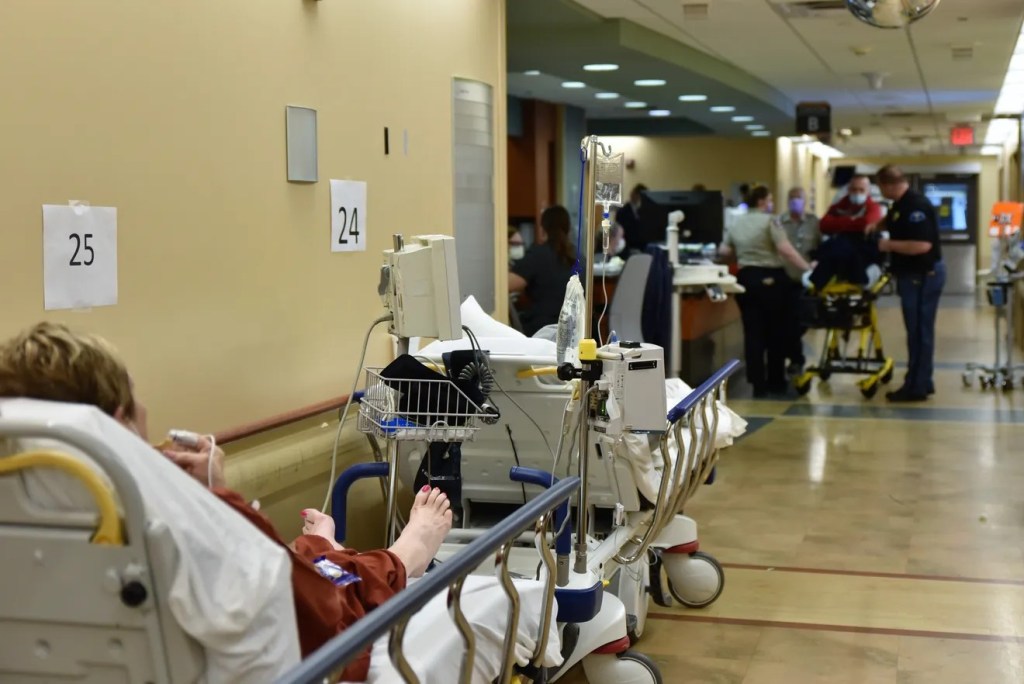
Upon arrival, the triage staff winced when they saw your hand and were amazed at your complacent demeanor. No room was available, so we were assigned to a hospital bed in the hall, under our number: 31. The ER had numbers posted every few feet along the top of the wall, and we cot-dwellers were laid head to toe up and down the corridors. I found myself thinking, with some relief, about the fact that I had filed my taxes several weeks early that year — the first time since my 2005 breast cancer diagnosis that I hadn’t needed an extension. I had clicked submit in February and felt it as a small marker of something returning to normal. Something to hold onto while everything else was not.
A nurse said your hand wasn’t as bad as it looked and that pain medicine would have to wait until a doctor saw you. Eventually a nurse practitioner came along and began her examination. As she asked how you’d been injured and you couldn’t recall, she explored further — and that exploration unleashed fifteen months of my built-up anguish. I described your transformation: from the wonderful, caring, hardworking spouse I knew into a hostile stranger with constant blinding headaches who never slept, who had massive nosebleeds in the middle of the night that he didn’t seem to notice, so I would clean them up in the morning. She listened. Then she asked whether you had ever had a brain scan. No, I told her. She said that while you were here, she would like to get one.
While we waited, I took in the comings and goings of our hall neighbors. I struck up a conversation with the patient in #30 and her sister — good company while you were gone for the scan.
The elderly woman in #32 was alone, facing the wall, her head buried in a blanket while her arm dangled over the rail and intermittently bumped against the metal bar and the wall. I wondered how she got here. Had someone just dropped her off? She looked in no condition to drive. Surely if she had come in an ambulance she wouldn’t be in the hall, would she? She seemed so weary during interactions with ER staff. Her skin was dry and fragile looking, and I worried she wasn’t drinking enough water. She looked cold and I wondered if she wanted something warm to drink or another blanket, but I wasn’t sure if it was OK for me to check on her. Later after we left the ER, I thought about how if her head had been at Jose’s feet instead of his head at her feet, then I would have been close to her head, and probably I would have spoken to her to see if she was cold.
It was close to 10 pm when your hand was set. By then #30 was a school-age child, miserable and inconsolable, and #32 had an IV and was waiting on a hospital room. Then, instead of the nurse practitioner, a new white coat appeared at #31 bearing a manila envelope. I knew from three years of cancer treatment that it is not a good sign when you get kicked up the healthcare hierarchy after a scan. (I have no record of this doctor’s name, so I will call him the Doctor with the Envelope )
He introduced himself and explained that the CT showed a large mass spanning both frontal lobes.
You slept peacefully beside me — something I had longed to see for over a year — as he explained that a neurosurgeon referral had been made and “they would be in touch”. My Advocate self sprang to life the moment he handed me the envelope and began to turn away.
I stopped him, whipped out pen and paper, and methodically questioned him about every detail: what had been found, how the referral process worked, and could I have a copy of the scan CD and the report. As I scribbled notes on the outside of the onerous manila message, the Doctor with the Envelope turned back and reviewed the scan and our situation. Somewhere in that interrogation — not before, not after — he ordered steroids to reduce brain swelling. I have always believed he was ready to hand off the envelope and move on to the next patient. I don’t think the steroids would have happened on their own.
I told him I wished I had thought to note the nurse practitioner’s name. I told him how much I appreciated that she had listened — really listened — during the intake. In just a few minutes she had identified a problem that had gone undiagnosed by multiple doctors across dozens of hours of interaction. I asked him to express my gratitude and respect to her, and to let her know she was more than a healthcare provider. She was a true healer.
Then I told him about #32 — that she looked cold, and the bright light seemed to bother her. Could she please get an extra blanket, and a pillow placed under her arm so she wouldn’t keep bumping against the rail with her thin skin?
Before I woke you, I paused to savor the miracle of watching you sleep. I felt grateful to finally have an answer to the question I had been asked hundreds of times in the last year: What is wrong with José? He looks terrible. I marveled that the nurse practitioner had ordered a brain scan for a patient with no insurance who came to the ER with an injured finger. I seethed about the three previous ER visits for excruciating headaches when no scan had been ordered. And then I recalled the Condescending Cardiologist and her stinky face.
I laughed out loud. Reluctantly I woke you so we could leave the ER and go home.
“I thought it would get better on its own.”
— José, April 15, 2009
 I Want to Tell You
Leave a comment